No results found
Loading...
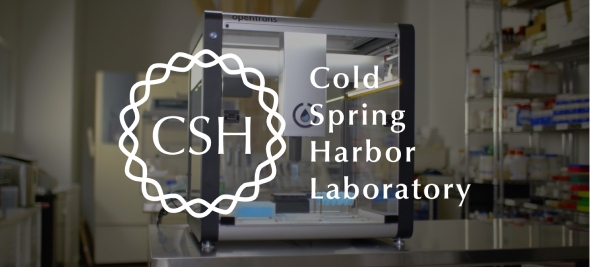
Impactful student learning doesn’t always take place in a traditional classroom. Dr. Joeli Marrero and the educator team at the Cold Spring Harbor Laboratory DNA Learning Center (DNALC) know that access to new technology and science at the community level can make all the difference. Their latest efforts use the Opentrons OT-2 to streamline their existing projects and make room for new hands-on learning opportunities.
As a part of the Opentrons for Education initiative, we’re speaking with educators like Joeli to take a look at the unique ways Opentrons liquid handling robots are used to teach students around the world.
At-a-glance
| Student activity | Student internships | Biocoding camp |
| Student level | Undergraduate | High school |
| Time | 3 months | 1 week |
| Number of students | 1 | 18 |
| Student:robot ratio | 1:1 | 18:1 |
| Automation on the OT-2 | Independent automation tasks supervised by DLC educatorsAutomate workflows to support large projects, like DNA Barcoding | Students write code to automate a variety of scientific tasksOn the OT-2, students see code output in real time and explore advanced workflows in drug discovery |
Educator Profile
Dr. Joeli Marrero proudly describes herself as a lover of bacteria. As an educator at the New York City–based DNALC, she introduces students to the fundamentals of DNA, bacteria, and viruses, helping them discover the excitement of scientific exploration.
Her own journey into science began while she was pursuing her bachelor’s degree at the University of Puerto Rico. It was there, she says, that she was first “bitten by the research bug.” Dr. Marrero later earned her PhD in microbiology and molecular biology from Tufts University School of Medicine and completed a postdoctoral fellowship at Weill Cornell Medical College. During her postdoctoral research, she focused on discovering new antibiotics to treat tuberculosis.
After spending time teaching at a university, raising her family, and working in medical communications, Dr. Marrero found an opportunity at the DNALC that brought together her interests in science, education, and research. “I never thought a job like this could exist,” she says.
At the DNALC, she values the flexibility to focus on sparking students’ curiosity rather than meeting traditional academic metrics tied to grades, degrees, or funding. The role also allows her to continue pursuing her own scientific interests. Outside the classroom, Dr. Marrero is experimenting with synthetic biology techniques to engineer bacteriophages—viruses that infect bacteria.
“I have a lot of leeway here at the DNA Learning Center,” she explains. “I approach each new group of students like a DJ—I read the room and adjust the lesson based on what they’re most curious about and excited to learn. And like a live DJ set, every science lesson I deliver in the lab is uniquely tailored to the group I have that day.”
Democratizing DNA
Since 1988, the DNA Learning Center has given students and community members the opportunity to “get their hands dirty with DNA.” Their foundation has always been putting new technology in students’ hands. Founder and Executive Director Dave Micklos drove the affectionately named “Vector Van” cross-country to introduce students to micropipettes, an unheard-of technology in the late ‘80s. Since then, the DNALC has grown steadily into an international network of centers and educators. “Not all brilliant minds have access to the ‘spark’ of touching equipment,” Dr. Marrero explains. She sees history repeating itself with automation in the lab. “This type of technology will be more and more commonly used, just like micropipettes are today,” she says. “Students often wouldn’t see automation until their first industry job, but we want them to know they can do it.”
The primary aim of the DNALC is to eliminate the barriers that prevent students from gaining hands-on experience with new technologies. Today, the DNALC not only reaches thousands of students a year, but also serves the local community. Weekend programs like Saturday DNA! can be attended by any community member, from Girl Scouts to book clubs. Dr. Marrero even sees senior citizen attendance. “If you are middle-aged and want to learn about DNA, what are your options?” she says. “Here, we have one.” Both senior and school groups book the DNALC’s one-day field trips, completing activities like a DNA “crime lab.” Week-long camps, offered throughout the summer, provide a more in-depth learning experience for middle and high school age students. And early undergraduate students are eligible for paid internships, where they’re mentored directly by DNALC educators. Even teachers can feel the “spark,” according to Dr. Marrero. She sees it every year at the DNALC’s hands-on teacher trainings, designed to help educators bring new technology into their classrooms.
Interns and the OT-2
When Dr. Marrero began working at the DNALC, she found an OT-2 in her workspace. No one she asked knew how to use it, but she thought it might make a great project for her first summer intern. Over the following weeks, Neal Mehta spent time on the phone with Opentrons’ customer support and dug out needed parts to get the OT-2 up and running. He even gave a presentation to the DNA Learning Center team , showcasing their latest technology and its potential applications. Dr. Marrero was thrilled to see the OT-2 come to life. “The use of automation nurtures students that are autodidactic,” she says. Once they teach themselves, they gain the experience needed to teach others.
Dr. Marrero put the OT-2 to its second test in the DNALC’s DNA Barcoding project. In this citizen science project, students around the world mail plant and insect samples from their communities to the DNALC for sequencing and species identification. Because the project is open to anyone, the DNALC’s freezers quickly overflow with DNA samples awaiting testing. Clodagh McNamara, a summer intern, programmed the OT-2 to convert hundreds of sample tubes to 96-well plates, automating a tedious task and keeping it error-free. “Doing this by hand would have increased the error rate of the DNA library collection,” she explains. Her intern continued to expand the automation project to create an online library for their DNA database, and the OT-2 protocols she wrote will continue to automate the DNALC’s collection management.
After two summers, Dr. Marrero wanted to see even more. In her experience, students using the OT-2 needed very little training to get started and could troubleshoot on their own. “The students are just so good at it,” she says, “almost like a fish to water.” Seeing her students’ independence, Dr. Marrero has plans to expand the use of the OT-2 in DNALC camps and training.
Translating science in code
Each summer, the DNALC’s popular BioCoding camp teaches high school students to translate science into code. Dr. Marrero is looking forward to this summer’s camp, where students will see real-time output of their code on the OT-2. This year, she plans to bring her interests in drug discovery to the DNALC, giving students a real problem to solve with automation. Joeli sees this as a real way for students to understand the power of automation. “You can screen 1,000 compounds by hand, or you can screen 10 well plates on the OT-2,” she says. “Removing hand pipetting allows students more time for troubleshooting, analyzing data, and thinking.” After a week of hands-on learning, students receive a certificate in biocoding. Through the DNALC, both students and community members can access experiences like these to gain an edge in applying to entry-level industry jobs or universities.
Looking ahead
One challenge faced by a community-focused center like the DNALC is engaging learners of every age. Dr. Marrero explains that it can be difficult to hold the attention of younger students, particularly when it comes to the precise reason scientists automate in the first place. Not only do students need to understand the scientific process they’re automated, but educators have to find a way to keep them engaged while the OT-2 runs the protocol, replacing much of their hands-on lab work. To combat both, Dr. Marrero plans to bring a new idea to the DNALC’s Saturday DNA! program. She’ll use the OT-2 in a game of automation “Battleship.” A 96-well plate serves as the “ocean,” and students place “ships” by filling random wells with a dye, colorless at a neutral pH. Their opponent chooses a well for the OT-2 to pipette acid into, causing the dye to turn pink when a ship is “hit.” By using no-code tools like Opentrons Protocol Designer to program the OT-2, this activity will be accessible to even the youngest students at the DNALC.
As automation programs expand at the DNALC, Dr. Marrero and the DNALC educator team welcome new ideas and partnerships. Collaborations with industry partners and education institutions help bring new opportunities and workforce-specific training to the students and community members they serve. You can even open a DNA Learning Center in your own community through the DNALC’s novel licensing program. These relationships align perfectly with the DNALC’s primary goal, to train the next generation of scientists in their own backyard. If you have an idea that could help bring automation to young scientists, you can reach Dr. Joeli Marrero at [email protected].